Rahu Kaal Today: Daily Timing Guide
Rahu Kaal today can feel confusing if you only see a warning label in a calendar app: “avoid this time.” In Vedic astrology, Rahu Kaal is not a panic window. It is a daily shadow period used for mindful scheduling, especially when you are about to begin something fresh.
This guide explains what Rahu Kaal means, how it is calculated, what to avoid, and what you can still do during the period. Use it with the Yamaganda Kalam and Gulika Kalam guide, the Panchang calculator guide, and the Choghadiya today guide when you want a fuller timing check.
What Is Rahu Kaal?
Rahu Kaal, also called Rahu Kalam, is a daily time segment traditionally considered less supportive for starting new ventures. Rahu represents shadow, uncertainty, obsession, shortcuts, and sudden turns. When a Muhurat or Panchang system marks Rahu Kaal, it is asking you to pause before initiating important actions.
That does not mean the entire day is bad. It also does not mean existing work must stop. Rahu Kaal is best understood as a caution window for beginnings. If a task is already underway, you can continue it. If the task is routine, unavoidable, or corrective, you can usually proceed with steadiness.
The practical mindset is simple: avoid unnecessary launches; use the time for review, cleanup, mantra, planning, or low-risk admin.
How Rahu Kaal Is Calculated
Rahu Kaal depends on local sunrise and sunset. The daytime period from sunrise to sunset is divided into eight equal parts. One part is assigned to Rahu based on the weekday.
Because sunrise and sunset change by location and season, Rahu Kaal today will not be identical for Mumbai, Delhi, London, or New York. Always check a local Panchang rather than relying on a generic fixed time.
Here is the usual weekday order:
| Weekday | Rahu Kaal segment | Simple memory cue |
|---|---|---|
| Monday | 2nd part of daytime | Avoid early mid-morning starts |
| Tuesday | 7th part | Late afternoon caution |
| Wednesday | 5th part | Mid-afternoon caution |
| Thursday | 6th part | Afternoon caution |
| Friday | 4th part | Around midday caution |
| Saturday | 3rd part | Late morning caution |
| Sunday | 8th part | Near sunset caution |
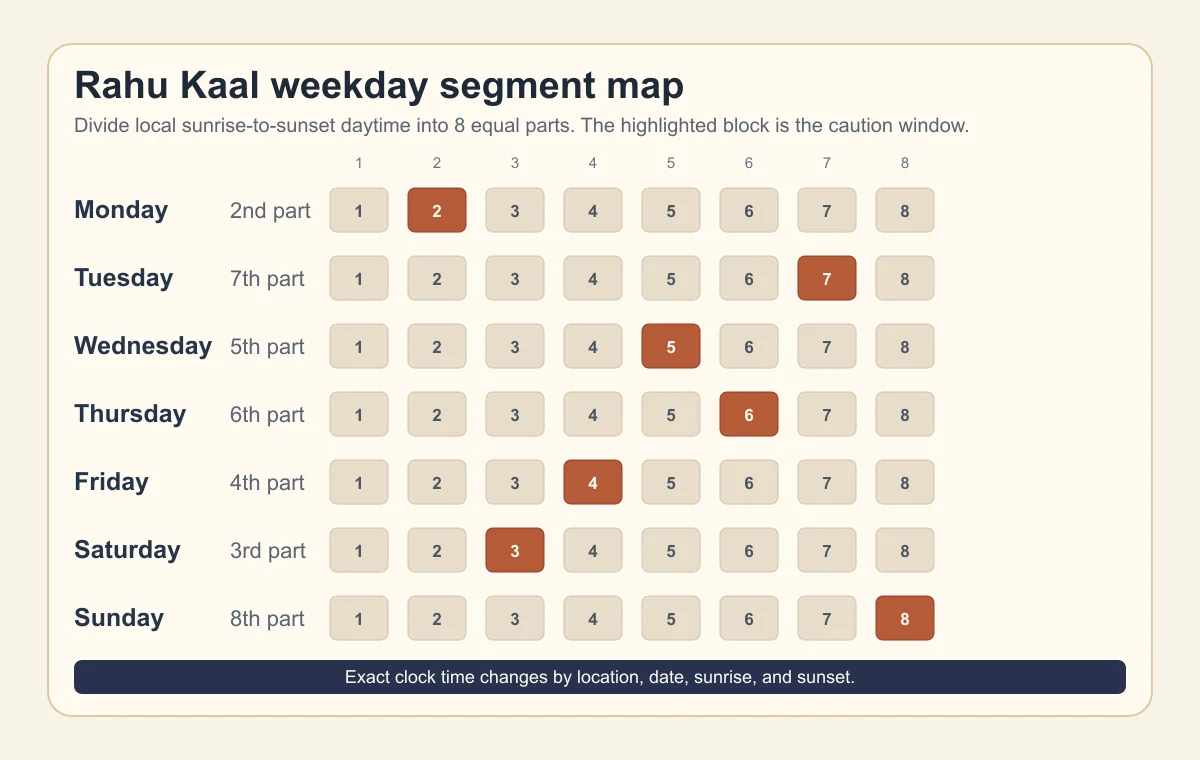
For exact timing, use your local sunrise and sunset. If sunrise is 6:00 AM and sunset is 6:00 PM, each segment is 90 minutes. On Monday, the second segment would run roughly 7:30 AM to 9:00 AM. But if your day length is longer or shorter, the window shifts.
What To Avoid During Rahu Kaal
Use Rahu Kaal timing as a filter for activities that carry symbolic importance, public visibility, or long-term consequences. If you can choose another window, avoid starting:
- Business launches, store openings, or first sales calls
- Signing a new contract or making a major commitment
- A first meeting for marriage, partnership, or negotiation
- Buying a vehicle, property, or expensive asset
- Beginning a journey that has flexibility
- Starting a new spiritual vow, remedy cycle, or puja without guidance
For important ceremonies or high-stakes beginnings, Rahu Kaal is only one layer. You should also review Tithi, Nakshatra, weekday lord, Choghadiya, Tarabala, and the charts of the people involved. The best days for planetary remedies guide explains how to combine these factors without overcomplicating the process.
What You Can Do During Rahu Kaal
Rahu Kaal is not useless time. In fact, it can be helpful for shadow work and unfinished business. Use the period for tasks that involve review, correction, research, or inner steadiness.
Good Rahu Kaal activities include:
- Reviewing documents before signing later
- Fixing errors in a plan, spreadsheet, or travel booking
- Cleaning clutter, inboxes, devices, or old files
- Chanting Rahu mantras quietly if you already follow that practice
- Journaling around fear, comparison, addiction, or distraction
- Preparing materials for a launch that begins after Rahu Kaal
- Continuing routine work that started earlier
This is where Rahu’s symbolism becomes useful. Rahu can reveal what is unclear, exaggerated, or driven by impulse. Instead of forcing a new beginning, use the window to ask, “What am I not seeing yet?”
Rahu Kaal vs Choghadiya vs Abhijit Muhurat
Many people get stuck because one calendar says “Rahu Kaal” while another says “good Choghadiya.” When timing signals conflict, use a clear hierarchy.
Rahu Kaal is a caution period for new starts. Choghadiya today is a quick daily timing system that classifies smaller windows as supportive, neutral, or difficult. Abhijit Muhurat is a widely used midday auspicious window, though it can still need adjustment for specific days and locations.
For everyday choices, use this order:
- Avoid Rahu Kaal for fresh beginnings when you have flexibility.
- Choose a supportive Choghadiya for practical tasks like travel, meetings, or purchases.
- Use Abhijit Muhurat for quick starts when a full Muhurat analysis is not available.
- For ceremonies, marriage, surgery, or major commitments, seek a personalized Muhurat.
If you are building a daily astrology habit, pair this guide with the Vedic horoscope daily Panchang method. That workflow helps you interpret Rahu Kaal alongside Tithi, Nakshatra, and transits.
A Simple Daily Rahu Kaal Routine
Here is a practical routine that takes less than three minutes:
- Check today’s local sunrise and sunset in a Panchang app.
- Note the Rahu Kaal start and end time for your location.
- Move new beginnings outside that window if it is easy to do.
- Put review, admin, mantra, or preparation work inside the window.
- If something unavoidable falls during Rahu Kaal, proceed calmly and avoid fear-based thinking.
The last step matters. Vedic astrology works best when it increases awareness, not anxiety. A delayed meeting or unavoidable appointment does not automatically create a bad outcome. Your preparation, intention, and conduct still matter.
Frequently Asked Questions
Is Rahu Kaal the same every day?
No. Rahu Kaal changes by weekday and by local sunrise and sunset. The weekday decides which segment belongs to Rahu, while your location decides the exact clock time.
Can I travel during Rahu Kaal?
If the journey is flexible, begin after Rahu Kaal. If the travel is already scheduled or unavoidable, do not panic. Leave prepared, avoid rushing, and use a brief grounding practice before departure.
Can I do remedies during Rahu Kaal?
Quiet mantra, reflection, and remedial preparation can fit Rahu Kaal, especially for Rahu-related work. For starting a new remedy vow or major puja, choose a cleaner Muhurat or consult an astrologer.
What if Rahu Kaal overlaps with a good Choghadiya?
For new beginnings, avoid the overlap if possible. Use the good Choghadiya after Rahu Kaal ends. If the activity is routine or already underway, you can continue with awareness.
Final Takeaway
Rahu Kaal today is a scheduling signal, not a sentence. Avoid using it to frighten yourself or delay everything. Instead, treat it as a daily pause for clarity: postpone fresh starts when practical, use the time for review, and return to action with a cleaner mind.
For bigger timing decisions, start with the Panchang calculator guide, compare Choghadiya, and then speak with a trusted astrologer when the event is truly important.
Continue your astrology study
Related guides and tools
Learn what Abhijit Muhurat today means, how the local midday window is calculated, when to use it, and when a full Panchang check is safer.
vedic basics Choghadiya Today: Daily Muhurat Guide for Practical TimingLearn how to read Choghadiya today, choose supportive windows for travel, meetings, purchases, and daily starts, and balance it with Panchang caution periods.
vedic basics Yoga and Karana in Panchang: Daily Timing GuideLearn what Yoga and Karana mean in the daily Panchang, how they differ from Tithi and Nakshatra, and how to use them for grounded Vedic timing.
festivals rituals Yamaganda Kalam and Gulika Kalam: Daily Panchang Timing GuideLearn how Yamaganda Kalam and Gulika Kalam fit into daily Panchang planning, how they differ from Rahu Kaal, and how to use caution windows without fear.
vedic basics Birth Chart Reading: What Should You Expect?Professional birth chart reading walkthrough: data needed, house analysis, timing methods, deliverables, and how to prepare.