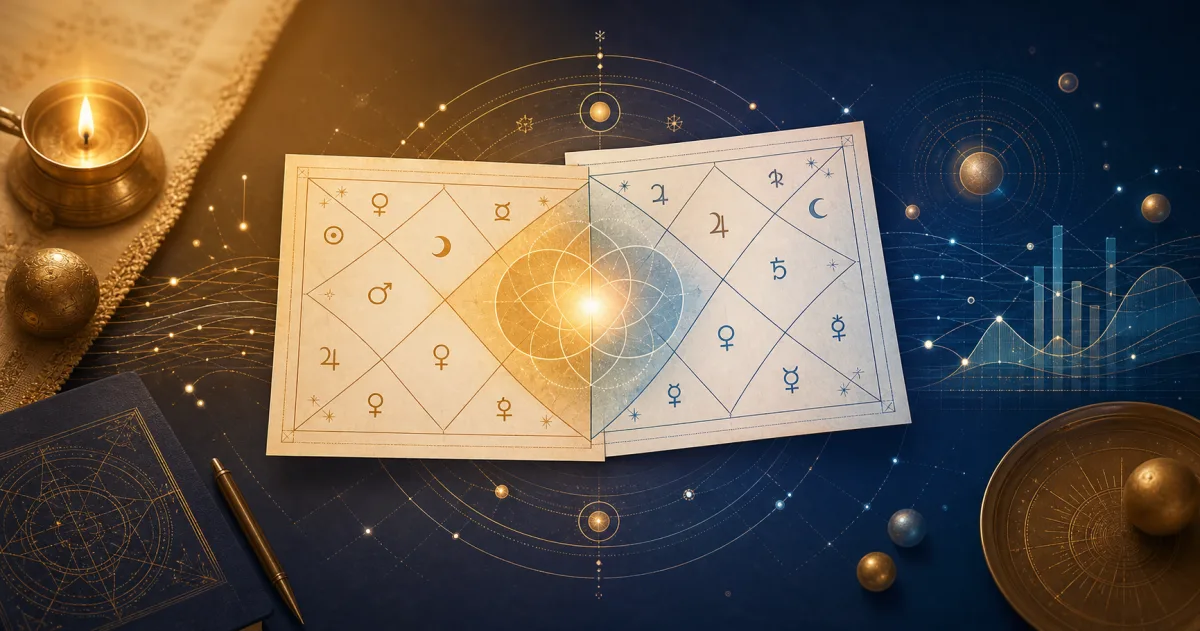
AI Kundli Matching: Compatibility Guidance That Stays Grounded
AI kundli matching is changing how couples explore compatibility: instead of waiting days for a basic chart comparison, you can now see Guna Milan scores, Moon-sign dynamics, and relationship themes within minutes.
That speed is useful, but compatibility is too personal to reduce to a single number. The best AI readings work like a structured first pass. They organize the astrology, flag important patterns, and help you ask better questions before making emotional or family decisions.
This guide explains how AI-based kundli matching works, what it can read well, where human judgment still matters, and how to use the result without treating astrology as a fixed verdict.
What AI Kundli Matching Actually Does
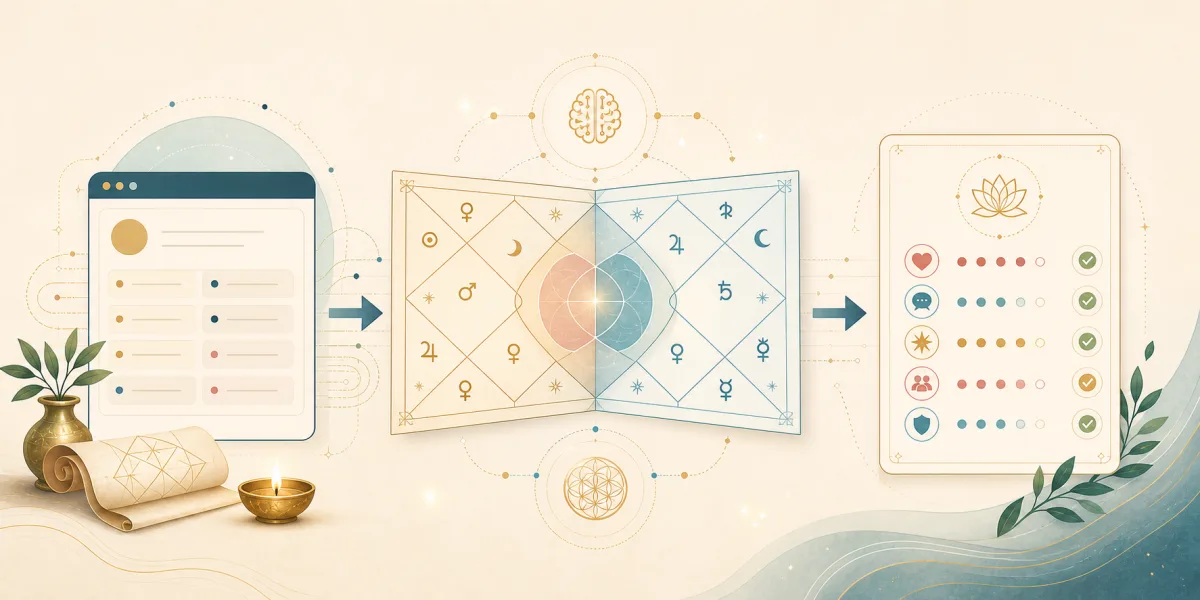
AI kundli matching combines automated chart calculation with interpretation rules from Vedic astrology. When both partners enter birth date, time, and place, the system calculates planetary positions, Moon signs, Nakshatras, house placements, and matching factors. It then turns those inputs into a readable compatibility report.
Most systems begin with Guna Milan, the traditional 36-point Ashtakoot score used in marriage matching. A stronger tool goes further by checking Manglik factors, 7th-house conditions, Venus and Jupiter strength, Dasha timing, and areas where two people may need conscious effort.
If you are new to the scoring system, start with the Guna Milan calculator guide before interpreting an AI report. The score is useful, but it becomes much clearer when you understand what Varna, Vashya, Tara, Yoni, Graha Maitri, Gana, Bhakut, and Nadi are trying to measure.
The Three Layers a Good AI Match Should Read
A helpful AI compatibility report should not stop at “your score is 27/36.” It should explain the relationship in layers.
First, the calculation layer. This is where AI is strongest. It can calculate Moon signs, Nakshatras, Guna categories, planetary aspects, and house placements consistently. It also avoids simple arithmetic mistakes that can happen during manual work.
Second, the pattern layer. This connects chart factors into themes. For example, a high Graha Maitri score may show mental friendship, while a stressed 7th house may suggest that commitment requires patience and communication. AI can quickly surface these combinations so the couple knows what to review.
Third, the guidance layer. This is where the report should become practical. Instead of saying “this match is good” or “this match is bad,” it should describe strengths, tension points, timing considerations, and reflection questions. Compatibility guidance is most useful when it helps people behave with more awareness.
Where AI Compatibility Analysis Helps Most
AI is especially helpful when you need a clean overview before a deeper consultation. It can summarize both charts quickly, highlight mismatches, and show whether a low score is caused by one serious factor or several small differences.
It is also useful for couples who want to learn the logic behind matching. A well-written AI report can explain why Nadi matters, why Moon-sign friendship affects daily emotional rhythm, or why Dasha periods may make one phase feel heavier than another.
For families, AI can make discussions less vague. Instead of arguing from fear or hearsay, everyone can see the same factors on paper: score, category breakdown, sensitive areas, and possible remedies or counseling topics.
Use AI as a preparation tool before reading a more detailed guide like Kundli matching for marriage. The deeper context helps you avoid overreacting to one mismatch or over-trusting one high score.
Where Human Judgment Still Matters
Compatibility is not a spreadsheet. Two charts can look technically strong, but the people may have different values, emotional habits, or life goals. Two charts can also show challenges, yet the couple may handle them maturely through communication, commitment, and family support.
Human astrologers still matter when the chart has contradictions. A low Guna score with strong 7th-house support, a Manglik concern with cancellation factors, or a difficult Dasha period during wedding planning all need careful synthesis. AI can flag the issue, but a skilled astrologer can ask questions, understand context, and avoid extreme interpretations.
This is especially important for sensitive topics such as marriage delay, separation risk, fertility worries, or family pressure. Astrology should create clarity, not fear. No report should claim that a relationship is guaranteed to succeed or fail.
How to Use an AI Kundli Matching Report
Start with accurate birth details. A small birth-time error can change the Ascendant, house placements, and sometimes the Moon Nakshatra near sign or Nakshatra boundaries. If the birth time is uncertain, treat the reading as a broad compatibility overview rather than a final assessment.
Read the Guna score, but do not stop there. Note which categories are strong and which are weak. A moderate total with good mental friendship and shared values may feel easier in real life than a higher score with repeated emotional friction.
Then check the relationship houses and planets. Venus shows affection and harmony, Jupiter shows wisdom and support, Mars shows energy and conflict style, and Saturn shows commitment, delay, or responsibility. The 7th house and its lord remain central for partnership patterns.
Finally, translate the reading into real questions:
- Where do we naturally support each other?
- Which differences need honest conversation before commitment?
- Are family expectations adding pressure that the chart cannot “solve”?
- What practical habits would strengthen the relationship?
If you want the broader technology context, the AI Vedic Astrology Hub collects guides on AI readings, consultations, future trends, and when to combine automation with human support.
Red Flags in AI Matching Reports
Be careful with any tool that gives one-line verdicts. “Perfect match,” “dangerous match,” or “divorce guaranteed” are not responsible interpretations. Vedic astrology is conditional and layered; no single factor should override the entire chart or the lived reality of the couple.
Also watch for reports that never explain uncertainty. Good AI should tell you when birth-time precision matters, when a factor needs manual review, and when emotional or family context is outside the chart.
The safest reports use grounded language: “may indicate,” “can suggest,” “worth reviewing,” and “supportive when handled consciously.” That tone is not weakness. It is accuracy.
A Balanced Way Forward
AI kundli matching works best as a structured compatibility map. It can calculate quickly, explain clearly, and help couples prepare better questions. But the final decision should include emotional maturity, shared values, family realities, and human guidance when the stakes are high.
Use the report to understand patterns, not to outsource your judgment. If the match looks promising, discuss the practical themes it raises. If the match looks challenging, slow down, seek context, and explore remedies or counseling before drawing conclusions.
For a more personal next step, try a guided AI astrology reading with complete birth details and use the result as a conversation starter, not a final verdict.
Continue your astrology study
Related guides and tools
Instant astrology consultations: how they work, types of readings, and getting immediate Vedic guidance for your questions.
modern Gaming Compatibility: Find Perfect Duo 2026Gaming compatibility by zodiac - find your perfect duo partner! Vedic astrology compatibility matrix for co-op archetypes, comms chemistry, and queue timing.
other Kundli Matching: Guna Milan & ChemistryKundli matching guide - understand Guna Milan, 36-point compatibility system, doshas, and marriage predictions. Complete Vedic astrology compatibility analysis.
modern AI Astro Consultations: How Readings WorkHow AI astrology consultations work: automated calculations, personalized insights, instant delivery, and what to expect.
modern AI Astrology Emerging Trends: Latest Innovations 2025Emerging AI astrology trends: voice interactions, predictive analytics, AR visualization, and innovations transforming Vedic.