Nakshatra Finder: How to Find Your Birth Star
Your Moon sign tells you the broad emotional weather of your chart, but your Nakshatra shows the finer texture: instinct, memory, motivation, compatibility style, and the starting point of your Dasha timeline. That is why a good Nakshatra finder is more than a lookup tool. It helps you understand which lunar mansion the Moon occupied when you were born, then turns that detail into practical self-reflection.
This guide explains how to find your birth Nakshatra, what inputs matter, how the 27 Nakshatras and four padas work, and how to use the result without making rigid assumptions about your future.
What Is a Birth Nakshatra?
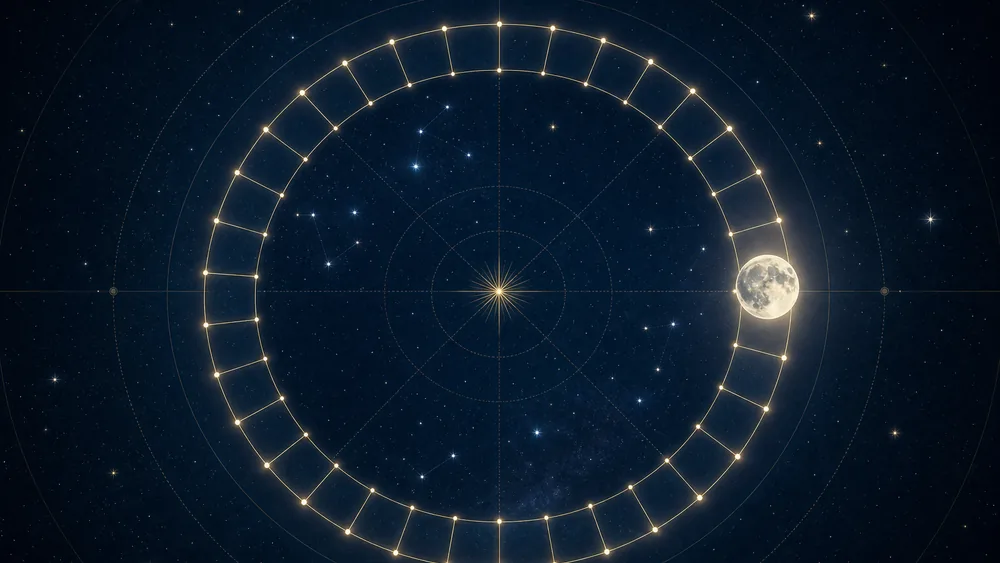
A Nakshatra is one of the 27 lunar mansions used in Jyotish, or Vedic astrology. Each Nakshatra covers 13 degrees and 20 minutes of the sidereal zodiac. Your birth Nakshatra is the segment where the Moon was placed at your exact birth moment.
Because the Moon represents the mind, emotions, habits, and instinctive reactions, the birth Nakshatra is often used for:
- understanding temperament and emotional needs
- choosing compatible timing for rituals and planning
- starting the Vimshottari Dasha sequence
- reading compatibility through Guna Milan and Tara factors
- identifying recurring patterns in daily Moon transits
For a broader overview of all 27 lunar mansions, start with the Nakshatras guide. This post focuses on the practical “how do I find mine?” workflow.
The Three Details a Nakshatra Finder Needs
To identify your birth star accurately, gather three inputs:
- Birth date: Use the calendar date recorded at your birthplace.
- Birth time: The closer to official hospital or family records, the better.
- Birthplace: City and country are needed because time zone and coordinates affect the chart.
If you know only an approximate birth time, your Moon sign may still be correct, but the Nakshatra can change near boundary points. The Moon takes roughly one day to cross a Nakshatra, so a person born close to a transition may need birth-time rectification from a qualified astrologer.
Use the free birth chart calculator to generate your Moon sign, Nakshatra, and Lagna in one place. Then come back here to interpret the Nakshatra result with more context.
Step-by-Step: How to Find Your Nakshatra
1. Generate a Vedic birth chart
Open a Vedic or sidereal birth chart tool. Make sure the setting is not Western tropical astrology unless the tool explicitly includes a sidereal option. Vedic Nakshatra calculations depend on the sidereal zodiac and an ayanamsha adjustment.
Enter your birth date, exact time, and birthplace. If the tool asks for a chart style, North Indian, South Indian, and East Indian formats can all work; the calculation is what matters.
2. Locate the Moon
In the chart output, find the Moon placement. It may be shown as “Moon,” “Chandra,” or a Moon glyph. Note the sign, degree, Nakshatra, and pada if the tool provides them.
For example, a chart might show:
| Field | Sample Output |
|---|---|
| Moon sign | Taurus |
| Moon degree | 12 degrees |
| Nakshatra | Rohini |
| Pada | 1 |
The Nakshatra name is your birth star. The pada is the quarter of that Nakshatra and adds extra nuance.
3. Confirm the pada
Each Nakshatra is divided into four padas of 3 degrees and 20 minutes each. The pada connects the lunar mansion to the Navamsa pattern, which is why two people with the same Nakshatra can still express it differently.
Use the pada as a refinement, not a label. It can point to tone, learning style, relationship expression, and how the Nakshatra energy becomes visible in daily life. The Nakshatra pada meaning guide explains the four-quarter pattern in more detail.
What Your Nakshatra Can Tell You
Once you know the birth Nakshatra, read it through four practical layers.
Emotional pattern
The Moon shows how you seek safety. A Pushya Moon may feel grounded through caretaking and structure, while an Ardra Moon may process life through intensity, research, and emotional release. Neither is better. Each has a different way of metabolizing experience.
Motivation and instinct
Nakshatras carry symbols, deities, shakti, and planetary rulers. These details reveal what naturally draws your attention. Ashwini often wants to start quickly. Rohini tends toward beauty and growth. Anuradha values loyalty and networks. Shravana learns through listening and repetition.
Dasha starting point
Your birth Nakshatra determines the first planetary period in the Vimshottari Dasha system. This is one reason the Nakshatra matters for timing. To understand how these life phases work, read the Dashas and planetary periods guide.
Compatibility clues
In traditional Kundli matching, the Moon’s Nakshatra is central to several compatibility factors. It can help compare emotional rhythm, instinctive comfort, and daily life harmony. Still, compatibility should not be reduced to one score. Use it alongside the 7th house, Venus, Jupiter, Mars, Dashas, and real-world communication.
For a practical relationship framework, see the Guna Milan calculator guide and the deeper compatibility basics in Vedic astrology.
Nakshatra Finder Mistakes to Avoid
Mixing tropical and sidereal results
Western astrology and Vedic astrology use different zodiac reference points. If one tool says your Moon is in Gemini and another says Taurus, this is often a system difference, not a calculation error. For Nakshatra work, use a Vedic sidereal chart.
Ignoring birth time near boundaries
If your Moon is close to the end of a Nakshatra, even a small birth-time error can shift the result. Do not force an interpretation if your data is uncertain. Mark it as “needs verification” and compare major life events with an astrologer if the detail matters.
Reading Nakshatra as destiny
Your birth star describes tendencies, not a fixed script. A challenging Nakshatra does not doom a person, and a celebrated Nakshatra does not guarantee success. The full chart, effort, environment, health, family support, education, and choices all matter.
Forgetting daily transits
Your birth Nakshatra is fixed, but the Moon moves through all 27 Nakshatras every month. Tracking the daily Moon can help you understand mood shifts, planning windows, and ritual timing. Pair this habit with the Vedic daily horoscope Moon sign vs ascendant guide for a balanced daily routine.
A Simple Birth Star Journal Practice
After you find your Nakshatra, try this for 27 days:
- Note the Moon’s daily Nakshatra in the morning.
- Record your mood, focus, and social energy.
- Mark whether the day supported action, rest, learning, repair, or connection.
- Compare the pattern when the Moon returns to your birth Nakshatra.
This keeps the practice grounded. Instead of memorizing every rule, you observe how lunar timing actually feels in your life.
When to Ask an Astrologer
A calculator can identify the birth star, but interpretation becomes more useful when it is connected to the full chart. Consider a consultation if:
- your birth time is uncertain
- the Moon is close to a Nakshatra boundary
- you want Dasha timing explained clearly
- you are comparing compatibility for marriage
- your chart has strong Rahu, Ketu, Saturn, or Mars influence on the Moon
The goal is not to become dependent on predictions. A good reading should make your chart easier to understand and your choices more intentional.
Final Takeaway
A Nakshatra finder gives you one of the most personal details in Vedic astrology: your birth star. Use it to understand emotional rhythm, Dasha timing, compatibility patterns, and daily Moon cycles. Keep the interpretation flexible, compare it with lived experience, and let it become a reflective tool rather than a rigid identity.
Ready to go deeper? Generate your chart with the free birth chart calculator, then explore the full Nakshatras guide to study the meaning of your birth star.
Continue your astrology study
Related guides and tools
Learn what Nakshatra padas mean in Vedic astrology, how to find your birth star quarter, and how to use it for chart reading without rigid labels.
vedic basics Vedic Zodiac Dates: Sidereal Rashi CalendarAccurate Vedic zodiac dates based on sidereal system. Learn each Rashi start/end date, and how to find your true signs using this guide.
vedic basics What's My Zodiac Sign? Sun, Moon & RisingWhat's your zodiac sign? Find your Sun, Moon & Rising signs with our free calculator! Complete guide to zodiac meanings, dates, and personality traits.
vedic basics Astrology Signs and Dates: Vedic vs Western GuideCompare astrology signs and dates in Vedic and Western systems, see sidereal Rashi ranges, learn why your sign changes, and find exact placements.
vedic basics Free Birth Chart Calculator: Generate & ReadGenerate free birth chart in 2 mins. Step-by-step guide to decoding Sun, Moon, Rising signs, planets, and house meanings.