
Birth Time Accuracy in Vedic Astrology: Rectification Guide
Birth time accuracy is one of the quiet details that decides whether a Vedic astrology reading feels personal or vague. Two people can be born on the same date and in the same city, yet a difference of a few minutes may shift the Lagna degree, house focus, divisional charts, and timing windows.
That does not mean you should panic if your recorded time is approximate. It means your chart should be read with the right level of confidence. A verified birth time can support detailed timing, compatibility, and varga work. An uncertain time calls for wider interpretation, event checking, and sometimes birth time rectification.
Why Birth Time Matters So Much
In Vedic astrology, the birth chart is calculated from three inputs: date, time, and place. The date sets the broad planetary positions. The place anchors the sky to your local horizon. The time determines the Lagna, or ascendant, and the exact house structure of the chart.
The Lagna changes sign roughly every two hours, but its degree moves continuously. Near a sign boundary, even a short error can change the ascendant sign. In other cases the Lagna sign stays the same, but the degree shifts enough to affect divisional charts, sensitive points, and dasha timing.
This is why an astrologer may treat a birth time written as “around sunrise” very differently from a hospital record that says “06:42 AM.” Both can be useful, but they do not carry the same precision.
If you are just starting, generate a chart with the best available details using the free birth chart calculator and note whether the time is exact, rounded, or remembered by family.
What Changes When the Time Is Off?
The most visible change is the Lagna. Since the ascendant sets the first house, it also decides the placement of all twelve houses. A wrong Lagna can make a career reading lean toward the 9th house when the real emphasis is the 10th, or make a relationship pattern appear in the wrong life area.
The Moon can also be sensitive. If the Moon was near the edge of a nakshatra or rashi on your birth day, a timing error can change the Moon sign, nakshatra, or pada. That affects emotional interpretation, daily horoscope logic, Guna Milan, and Vimshottari dasha starting balance. If only the quarter changes, the Nakshatra pada meaning guide can help you decide how much weight to give that detail.
Divisional charts are even more time-sensitive. The Navamsa D9, Dashamsa D10, Saptamsa D7, and other Vargas divide signs into smaller sections. A few minutes may not change the main D1 chart much, but it can move a planet into a different division. Read the divisional charts guide if you want to understand why Vargas require careful birth data.
Dashas can also shift. The broad Mahadasha may remain the same, but Antardasha boundaries and event timing can move. For life planning, the dasha periods guide explains why timing should be checked against real events rather than treated mechanically.
Exact, Rounded, or Unknown: Know Your Confidence Level
Before you interpret the chart, label your birth time source:
- Exact record: birth certificate, hospital record, or official document with a specific time.
- Rounded record: a time like 7:00, 7:30, or “after lunch” that may have been rounded.
- Family memory: useful but often approximate, especially after many years.
- Unknown time: no reliable time available.
An exact record is the strongest starting point, though even official records can contain clerical errors. A rounded time is still usable for many themes, but the astrologer should test nearby times. A remembered time can show broad patterns, but detailed varga and timing claims should stay cautious. If the time is unknown, some astrologers use Moon charts, solar charts, prashna, or rectification rather than forcing precision.
A Practical Birth Time Rectification Checklist
Birth time rectification is the process of refining a likely birth time by comparing chart changes with real life events. It is not guesswork, and it should not be used to force the chart to say what someone wants to hear. Good rectification looks for repeated alignment across Lagna, house lords, dashas, transits, and major milestones.
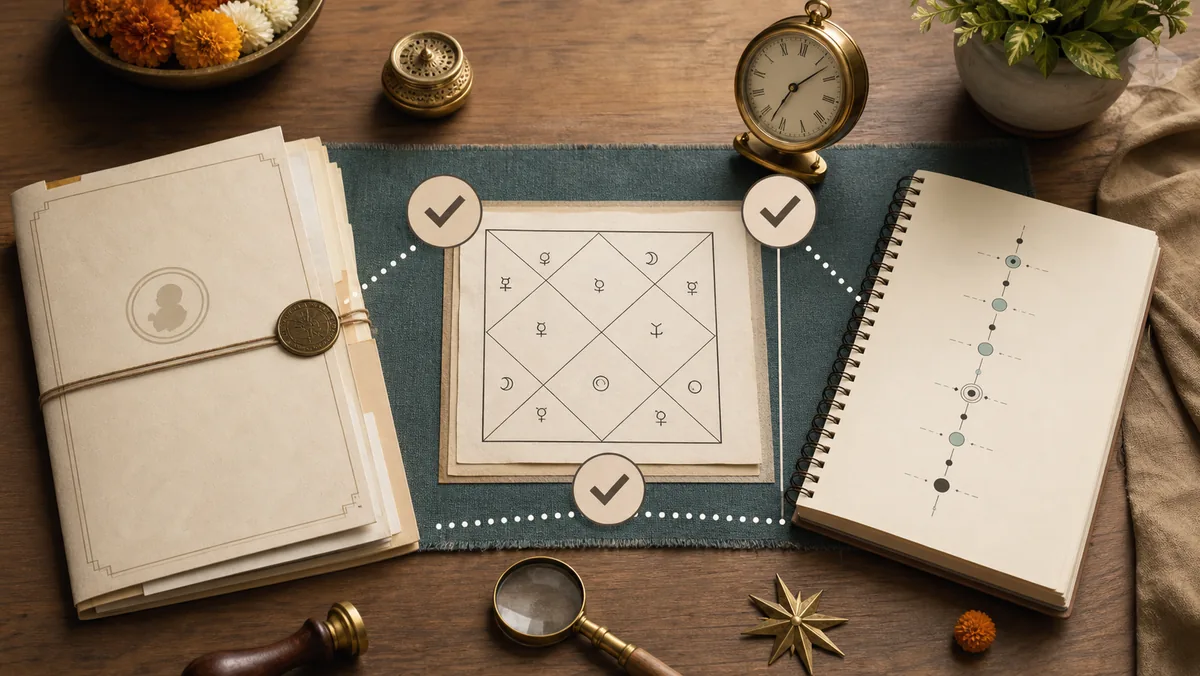
Prepare these details before a rectification session:
- Education milestones, major exams, degrees, and moves for study
- First job, promotions, business launches, job losses, or career pivots
- Marriage, engagement, separation, or major relationship turning points
- Birth of children or important family responsibilities
- Relocation, property purchase, immigration, or long-distance moves
- Health events, accidents, surgeries, or recovery periods, described factually
- Spiritual initiations, major losses, inheritances, or legal events
Dates matter more than dramatic stories. Exact month and year are useful; exact dates are better. If you only remember “around 2018,” say that clearly.
How to Test Your Chart at Home
You can do a simple sensitivity check before booking a full reading. Use the kundli chart calculator guide to generate your chart, then run the same birth data with times 5, 10, and 15 minutes earlier and later.
Look for what changes:
- Does the Lagna sign change?
- Do planets move houses?
- Does the Moon nakshatra or pada change?
- Do D9 or D10 placements shift noticeably?
- Does the dasha timeline change around key life events?
If nothing major changes within a 10-minute range, your chart may be stable enough for beginner-level reading. If several things change quickly, treat advanced predictions with caution until the time is checked.
Common Mistakes to Avoid
Do not round the time because it “looks cleaner.” If your record says 6:47 AM, do not enter 7:00 AM. Those thirteen minutes may matter.
Do not ignore AM/PM mistakes. A 12-hour error creates a completely different chart, and it is more common than people think when data is copied from family notes or old forms.
Do not use the current city if you were born elsewhere. Birthplace affects the local horizon, so use the actual birth city or nearest reliable location.
Do not assume rectification creates certainty. It improves confidence. A responsible astrologer will usually explain the confidence range rather than pretending every second is proven.
Most importantly, do not use uncertain birth data for fear-based conclusions. If the time is unclear, avoid absolute statements about marriage, health, death, children, or career failure. Astrology should guide reflection and preparation, not create panic.
When You Should Seek Rectification
Rectification is worth considering if your recorded time is rounded, if family members disagree, if your chart feels consistently misaligned with life events, or if you want to use sensitive techniques such as Vargas, exact dasha timing, marriage timing, or career timing.
It is also useful before major consultations. A good reading depends on good input. The online astrology consultation guide can help you prepare your birth data, questions, and event timeline before speaking with an astrologer.
Final Takeaway
Birth time accuracy does not make astrology deterministic. It makes the map clearer. With a reliable time, the Lagna, Moon, Vargas, and dashas can be interpreted with more confidence. With an uncertain time, you can still learn from the chart, but you should use wider themes, event testing, and grounded judgment.
Start with the best record you have, label your confidence honestly, and keep a timeline of major life events. If the chart will be used for an important decision, refine the time before asking for precise timing. For a practical next step, create your VedicGod chart, compare nearby birth times, and note which placements remain stable across the range.
Continue your astrology study
Related guides and tools
Free Kundli calculator tutorial! Learn to generate, read, and interpret your birth chart step-by-step. Complete guide with examples and accuracy validation.
vedic basics Birth Chart Reading: What Should You Expect?Professional birth chart reading walkthrough: data needed, house analysis, timing methods, deliverables, and how to prepare.
vedic basics Free Kundli Analysis: How to Read Your Birth ChartGenerate free Kundli online instantly. Get a complete Janam Kundli with detailed analysis, predictions, and AI-powered insights for life.
vedic basics Kundli Analysis: Read Birth Chart StepsLearn to read your Kundli like a pro! Step-by-step guide to chart layout, house meanings, planetary strength, and practical applications for daily decisions.
vedic basics Understanding Yogas in Birth Chart: A Beginner GuideLearn what yogas mean in a Vedic birth chart, how to check their strength, and how to use them as practical guidance without assuming guaranteed outcomes.