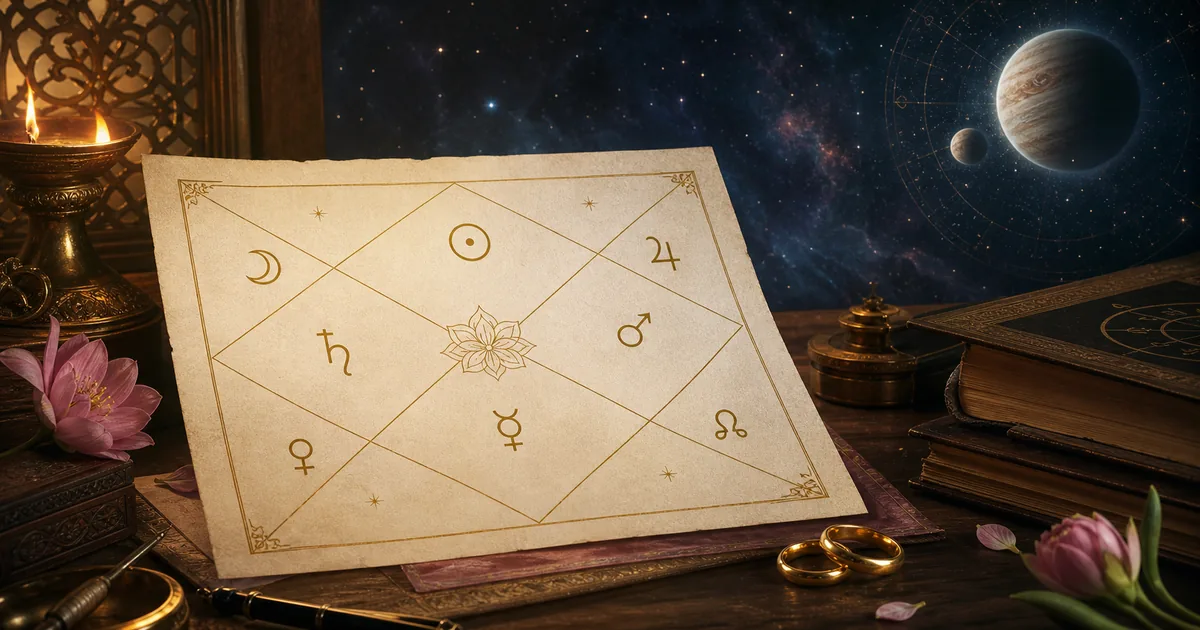
Navamsa D9 Chart: Marriage Reading Guide
The Navamsa D9 chart is one of the most useful tools in Vedic astrology for understanding how relationship potential matures over time. The birth chart can show attraction, marriage promises, and visible partnership patterns, but the Navamsa often reveals the deeper quality of commitment, dharma, and long-term compatibility.
That does not mean one D9 placement can guarantee a perfect marriage or predict failure. A healthy reading blends the main birth chart, the Navamsa chart, dasha timing, transits, and real-life maturity. Use this guide as a practical way to read D9 marriage themes with clarity instead of fear.
What the Navamsa D9 Chart Shows
Navamsa means the ninth division of a sign. Each 30-degree rashi is divided into nine smaller parts, creating the D9 chart. In relationship readings, astrologers use it to refine what the main birth chart already suggests.
The D9 chart is especially helpful for:
- Marriage quality and long-term relationship resilience
- The maturity of Venus, Jupiter, and the 7th house themes
- How partnership changes after commitment
- Whether a natal promise becomes smoother or more demanding with time
- Spiritual alignment, dharma, and values inside marriage
If you are new to Vargas, start with the divisional charts guide before reading D9 too literally. Vargas are not separate destinies. They are focused lenses.
First Rule: Do Not Read D9 Alone
A common mistake is opening the Navamsa chart and judging marriage from one planet. For example, someone sees Saturn in the D9 7th house and assumes delay, coldness, or disappointment. Another sees Venus strong in D9 and assumes marriage will be effortless.
Both readings are too narrow.
The main birth chart, or D1, must show the core promise first. Look at the 7th house, 7th lord, Venus, Jupiter, Moon, and relevant relationship yogas. Then use D9 to confirm the quality of that promise. If D1 shows partnership potential and D9 supports the 7th house, the marriage theme has depth. If D1 is strong but D9 is pressured, the relationship may still happen, but it asks for maturity, patience, and conscious effort.
For the broader partnership framework, pair this post with the advanced compatibility guide beyond Guna Milan.
The 5-Step D9 Marriage Reading Workflow
Use this sequence to keep the reading grounded:
- Check the D1 7th house and 7th lord.
- Study Venus for men and Jupiter for women as traditional marriage significators, while also reading both for all charts as relationship values and wisdom.
- Open the D9 lagna, lagna lord, 7th house, and 7th lord.
- Compare whether planets repeat themes between D1 and D9.
- Add dasha and transit timing only after the relationship promise is clear.
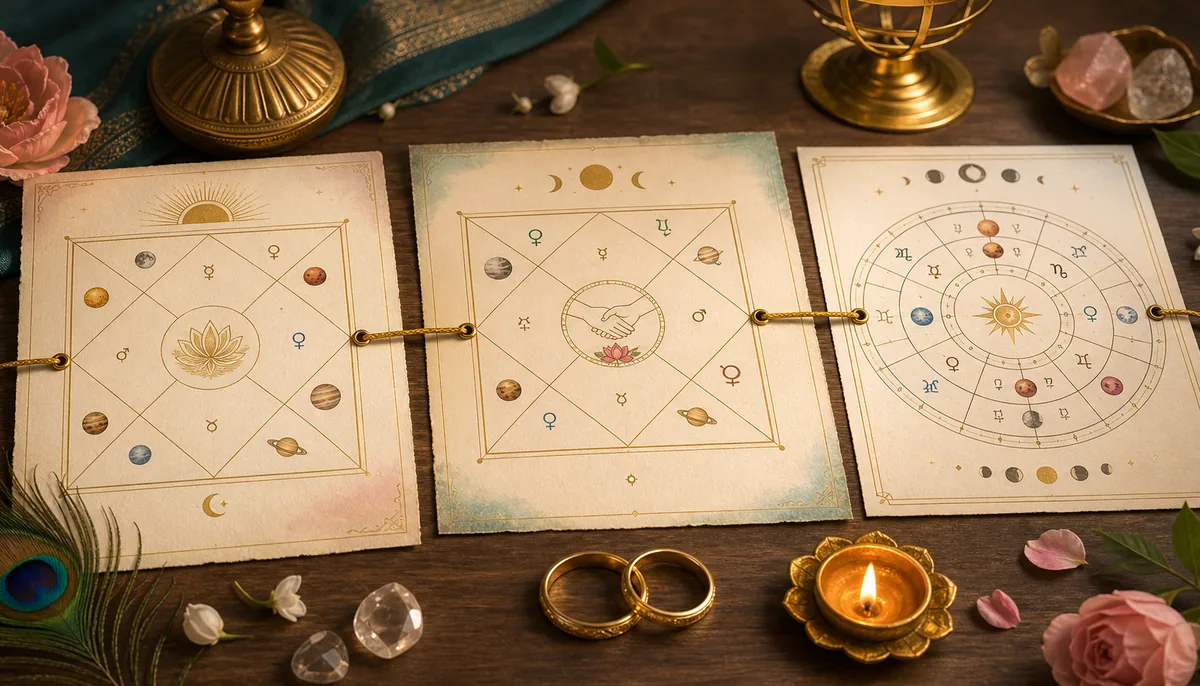
This order prevents panic. A single difficult placement becomes one data point, not the entire story.
Key D9 Houses for Marriage
The D9 lagna shows the inner tone of the married life and how a person matures through commitment. A strong D9 lagna lord suggests resilience and the ability to grow through partnership.
The D9 7th house describes the spouse dynamic after marriage. Benefic influence here can show support, warmth, and shared values. Malefic influence does not automatically mean separation; it can show responsibility, distance, discipline, strong boundaries, or the need to work through pressure with awareness.
The D9 2nd house matters because it reflects family life after marriage. The D9 4th house shows emotional peace and home atmosphere. The D9 9th house reflects shared dharma, blessings, teachers, and the values that keep the bond meaningful beyond attraction.
Planets to Watch in the Navamsa
Venus shows affection, enjoyment, harmony, attraction, and the ability to receive love. A strong Venus in D9 often supports grace in relationship life. A pressured Venus asks for better communication around expectations, pleasure, money, and emotional reciprocity.
Jupiter shows wisdom, faith, ethics, blessings, and the ability to grow together. A supportive Jupiter can soften hard placements. A weak Jupiter may show the need for counsel, humility, or a shared value system.
Saturn brings seriousness. In marriage readings, Saturn can show delay, duty, age gap, karmic responsibility, or a relationship that strengthens slowly. It is not only negative. Saturn often rewards consistency.
Mars brings passion, assertion, and conflict style. In D9, Mars needs constructive outlets. Without that, small disagreements can become battles for control.
Rahu and Ketu show unconventional patterns, cross-cultural relationships, detachment, obsession, or karmic intensity. Their placement needs careful synthesis with the D1 chart and the current dasha.
D9 and Marriage Timing
The Navamsa helps confirm marriage timing, but it does not replace dashas and transits. The strongest windows often involve activation of the 7th lord, Venus, Jupiter, D9 lagna lord, or planets connected to the D9 7th house.
Helpful timing signals include:
- Venus or Jupiter dasha/antardasha activating relationship houses
- 7th lord periods in D1 or D9
- Jupiter transiting or aspecting the 7th house, 7th lord, Venus, or D9 marriage points
- Saturn creating commitment pressure after a relationship has matured
- Repeated activation across D1, D9, and current gochar
For a deeper house-by-house approach, read the 7th house marriage analysis. It explains how the visible marriage house works before D9 refines the promise.
Common D9 Mistakes to Avoid
Do not assume a debilitated planet ruins marriage. Debilitation can show a growth area, especially if there is cancellation, benefic support, or improvement across divisional charts.
Do not use D9 without accurate birth time. Even a small time error can shift divisional chart placements. If your birth time is uncertain, treat D9 as exploratory, not final.
Do not compare charts mechanically. Two people can have average individual D9 charts but strong mutual support through Moon, Venus, Jupiter, and dasha alignment. Another pair may have beautiful attraction but weak timing or mismatched values.
Do not turn astrology into blame. A chart can show tendencies, but daily behavior, communication, respect, and accountability shape the relationship.
A Simple Self-Check for Your D9 Chart
Before asking whether your Navamsa promises marriage happiness, ask better questions:
- Is the D9 lagna lord strong enough to support maturity?
- Does the D9 7th lord have dignity, benefic support, or constructive discipline?
- Are Venus and Jupiter able to guide affection and wisdom?
- Do D1 and D9 repeat the same relationship theme?
- Is the current dasha actually activating marriage?
- What practical habit would improve the relationship pattern shown?
If you need your D1 and D9 charts first, generate your chart through the kundli chart calculator guide and confirm your birth time carefully.
Final Takeaway
The Navamsa D9 chart is not a verdict on love. It is a refinement tool. It shows how partnership potential matures, where commitment needs care, and which qualities help a relationship become more stable over time.
Read D9 after D1, confirm it with dashas and transits, and translate the insight into better choices. For personalized interpretation, use VedicGod to compare your main chart, Navamsa, and current timing before making major relationship decisions.
Continue your astrology study
Related guides and tools
Learn Vedic compatibility basics: Guna Milan score, Ashtakoot factors, Manglik checks, and when to use Kundli matching before marriage.
compatibility 7th House Marriage Prediction: Vedic Reading GuideLearn how 7th house marriage prediction works in Vedic astrology, including Venus, the 7th lord, Navamsa D9, dashas, and grounded compatibility checks.
compatibility Guna Milan Calculation: Step-by-Step 36 Guna GuideLearn how to calculate Guna Milan manually with our step-by-step guide. Free 36 Guna table explained with examples. Calculate your compatibility score now.
compatibility NRI Kundli Matching: Birth Details ChecklistNRI kundli matching guide for families comparing charts across countries: check birth time, timezone, Guna Milan, Navamsa, and practical compatibility questions.
compatibility Astrology Compatibility: Check Your MatchCalculate astrology compatibility yourself! Step-by-step guide using Sun, Moon, Venus signs + Guna Milan scoring for accurate relationship insights.