
NRI Kundli Matching: Birth Details Checklist
NRI kundli matching needs one extra layer of care: the chart is only as useful as the birth details behind it. When one person was born in India and the other was born abroad, families often compare charts without checking hospital time format, daylight saving, timezone conversion, or birthplace spelling. Small data errors can change the Ascendant, Moon degree, Navamsa, and Dasha sequence.
Quick answer: NRI kundli matching is the process of comparing two birth charts for marriage when one or both people were born or live outside India. Start by verifying exact birth date, local birth time, birthplace, and timezone. Then review Guna Milan, Manglik factors, Navamsa, current Dashas, practical values, and family expectations together.
Quick Navigation
- Why NRI Kundli Matching Needs Extra Care
- Birth Details Checklist for NRI Couples
- What to Review Beyond Guna Milan
- Questions to Ask Before a Consultation
- Frequently Asked Questions
Why NRI Kundli Matching Needs Extra Care
In a same-city match, birth data usually follows one local calendar and one familiar time convention. In an NRI match, the chart may involve 2 countries, 2 timezones, and sometimes daylight saving rules. That makes verification more important than speed.
Use Kundli Matching for Marriage for the core compatibility framework, but do not stop at a single score. A good marriage review should combine classical matching with practical context: where the couple will live, how careers may move, how families communicate, and what both people expect from married life.
NRI matches also need more sensitivity. Astrology can highlight compatibility patterns, but it should not be used to pressure either person. Treat the chart as a guidance tool, then confirm the relationship through conversation, shared values, and lived behavior.
Birth Details Checklist for NRI Couples
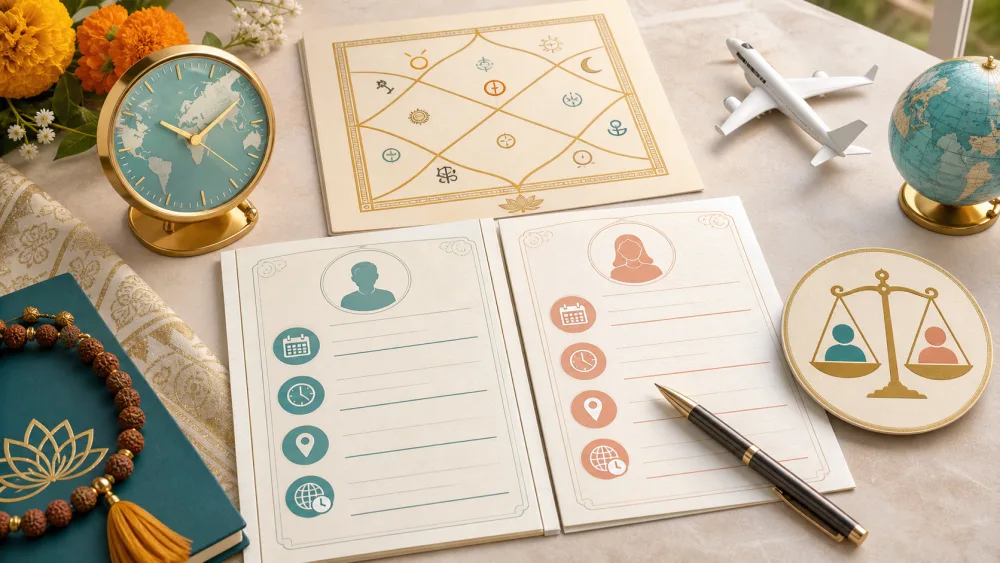
Before you calculate compatibility, collect the same set of details for both people. This avoids mismatched charts and reduces back-and-forth during consultation.
| Detail | What to confirm | Why it matters |
|---|---|---|
| Birth date | Day, month, and year from the birth certificate | Prevents date-format confusion like 07/02 vs 02/07 |
| Birth time | Exact local time, including AM or PM | Affects Ascendant, houses, and divisional charts |
| Birthplace | City, state/province, and country | Sets latitude and longitude for chart calculation |
| Timezone | Local timezone at birth | Needed when birth happened outside India |
| Daylight saving | Whether local clocks were adjusted | Can shift chart timing by 1 hour in some regions |
| Record quality | Certificate, hospital note, or family memory | Helps decide how much confidence to place in details |
If the birth time is approximate, say so clearly. A chart marked “around 6 AM” should not be interpreted with the same precision as a certificate time of 6:12 AM. In uncertain cases, an astrologer may compare life events before making firm comments about Lagna, Navamsa, or marriage timing.
5-Step NRI Kundli Matching Workflow
- Confirm birth details for both people in local time.
- Generate both charts using a consistent Vedic calculation system.
- Review Guna Milan using a clear 36-point breakdown.
- Check Navamsa, 7th house, Venus, Jupiter, Mars, and current Dashas.
- Discuss practical compatibility: location, career, family expectations, and emotional style.
For a score-focused starting point, read the Guna Milan Calculator Guide and the manual Guna table calculation method. These help families understand what the number means before moving into deeper chart analysis.
What to Review Beyond Guna Milan
Guna Milan is useful, but it is not the whole marriage chart. It compares 8 compatibility factors and gives a total out of 36 points. That score can support the discussion, but a serious NRI marriage review should go further.
Navamsa and Relationship Maturity
Navamsa, also called the D9 chart, is important for marriage quality and long-term relationship maturity. If the birth time is uncertain, Navamsa can shift quickly, so do not overstate it. Use the Navamsa D9 chart marriage guide to understand why this chart is read alongside the main birth chart.
Manglik and Mars Factors
Mars-related compatibility should be judged carefully. A simple “Manglik” label can cause unnecessary fear if the rest of the chart provides balancing factors. Review Mars placement, 7th house influences, strength of Venus and Jupiter, and whether both charts show similar intensity. The goal is not to declare a match impossible, but to understand temperament, conflict style, and practical remedies if needed.
Dasha Timing
Current Mahadasha and Antardasha periods show what life themes may be active for each person. A couple may have good overall compatibility but still face a demanding relocation, career transition, or family responsibility period. The Dasha Calculator Guide is a useful companion when timing questions come up.
Practical NRI Compatibility
For NRI couples, ask chart questions and life questions together:
- Will the couple live in India, abroad, or move between both?
- Are both families aligned on career, language, food, and rituals?
- How will festivals, elder care, and travel be handled?
- Are finances, visas, and long-distance timelines discussed openly?
- Does the couple have a realistic communication plan before marriage?
These points are not separate from compatibility. In many long-distance matches, they are the place where chart guidance becomes practical.
Questions to Ask Before a Consultation
Use this short worksheet before booking a kundli matching session:
- Are both birth times exact, approximate, or unknown?
- Was either person born in a daylight-saving region?
- Has either chart been calculated by more than one app with different results?
- Is the family asking only for a score, or for a full compatibility review?
- Are there specific concerns about relocation, career, family adjustment, or delayed marriage?
- Does either person want remedies, or only an interpretation?
If the match feels promising but the data is incomplete, ask for a birth time rectification conversation before making a final decision. If the data is strong, a full compatibility review can cover Guna Milan, Navamsa, Dashas, temperament, practical questions, and a balanced next step.
Common Mistakes to Avoid
The biggest mistake is converting the birth time to Indian Standard Time before entering it into a calculator that expects local birth time. Enter the time as recorded at the birthplace, then let the software handle location and timezone rules.
Another mistake is treating one weak factor as a final verdict. A lower Guna score, Mars placement, or difficult Dasha can be important, but each should be weighed against the whole chart and the couple’s real-world maturity.
Finally, avoid using astrology to replace consent. A match should support both people emotionally and practically. Kundli matching can guide reflection, but the couple’s willingness, communication, and shared decision matter most.
Frequently Asked Questions
Is NRI kundli matching different from regular kundli matching?
The core principles are the same, but NRI kundli matching needs extra care with birthplace, local birth time, timezone, and daylight saving. Once the charts are accurate, the review still covers Guna Milan, 7th house, Navamsa, Mars factors, Dashas, and practical relationship compatibility.
Should birth time be converted to Indian time?
Usually no. Use the local birth time from the birthplace and enter the correct birth city, state or province, and country. A reliable Vedic chart calculator should handle timezone conversion internally. Manual conversion can create avoidable chart errors.
What if one partner does not know the exact birth time?
Use the best available record, but label it as approximate. For marriage matching, exact time matters because Lagna, houses, Navamsa, and Dashas may change. If the match is serious, ask for birth time rectification before relying on fine chart details.
Is a high Guna Milan score enough for marriage?
No. A high score is encouraging, but it is not a guarantee. Review Navamsa, 7th house, Mars factors, emotional temperament, Dashas, family expectations, and life plans. Astrology works best when it supports practical conversation rather than replacing it.
Conclusion
NRI kundli matching works best when the process is patient and data-driven. Verify birth details first, calculate both charts consistently, then review Guna Milan, Navamsa, Dashas, and real-life compatibility together. For a deeper next step, start with a complete birth chart and then compare the charts with a qualified Vedic compatibility reading.
Continue your astrology study
Related guides and tools
Learn how to calculate Guna Milan manually with our step-by-step guide. Free 36 Guna table explained with examples. Calculate your compatibility score now.
compatibility Vedic Compatibility Basics: Guna, Ashtakoot, KundliLearn Vedic compatibility basics: Guna Milan score, Ashtakoot factors, Manglik checks, and when to use Kundli matching before marriage.
compatibility Guna Milan Calculator: Use & Read Compatibility ScoreComplete guide to the Guna Milan calculator. Learn to calculate and read your 36-point compatibility score for marriage matching in 2025.
compatibility Astrology Compatibility: Check Your MatchCalculate astrology compatibility yourself! Step-by-step guide using Sun, Moon, Venus signs + Guna Milan scoring for accurate relationship insights.
compatibility Manual Guna Milan Calculation Steps: Vedic MatchingManually calculate Guna Milan: step-by-step guide to mastering the 36-point marriage compatibility system with Vedic astrology.