Atmakaraka Meaning in Vedic Astrology
Atmakaraka is one of the most personal ideas in Vedic astrology. If your birth chart feels like a map of life patterns, Atmakaraka points to the planet that carries the strongest soul lesson in that map. It does not guarantee a fixed destiny, but it can help you ask better questions about desire, growth, repeated challenges, and the kind of maturity your chart keeps inviting.
Quick answer: In Jaimini astrology, Atmakaraka usually means the planet with the highest degree within its sign in your birth chart, excluding Rahu and Ketu in many modern calculations. It is read as the soul significator and is interpreted with the natal chart, Navamsa (D9), Karakamsha, dashas, and lived context.
Key Takeaways
- Atmakaraka is the “soul significator” among the Chara Karakas of Jaimini astrology.
- To find it, rank the seven visible planets by degree within their signs: Sun, Moon, Mars, Mercury, Jupiter, Venus, and Saturn.
- The planet with the highest degree becomes the Atmakaraka in the common seven-karaka method.
- It should be read with the Jyotish complete guide, the Dasha periods guide, and your D9 chart.
- Use it for self-reflection and timing awareness, not fear-based prediction.
What Is Atmakaraka?
Atmakaraka is the planet that represents the soul’s key learning theme in Jaimini astrology. “Atma” refers to the self or soul, and “karaka” means significator. In practice, it shows where your chart asks for deeper awareness, repeated effort, and more conscious choices.
Classical Jaimini methods use Chara Karakas, or movable significators, ranked by planetary degrees. A planet becomes Atmakaraka not because it is the most “good” or “bad” planet, but because it holds a leading symbolic role in the chart. For background on the larger system, see this scan of the Jaimini Sutras and Sanjay Rath’s discussion of Atmakaraka and Karakamsha.
How to Find Your Atmakaraka
Use a Vedic birth chart calculator that shows planet degrees. You need accurate date, time, and place of birth. If your birth time is uncertain, review the birth time accuracy guide before leaning too heavily on advanced chart details.
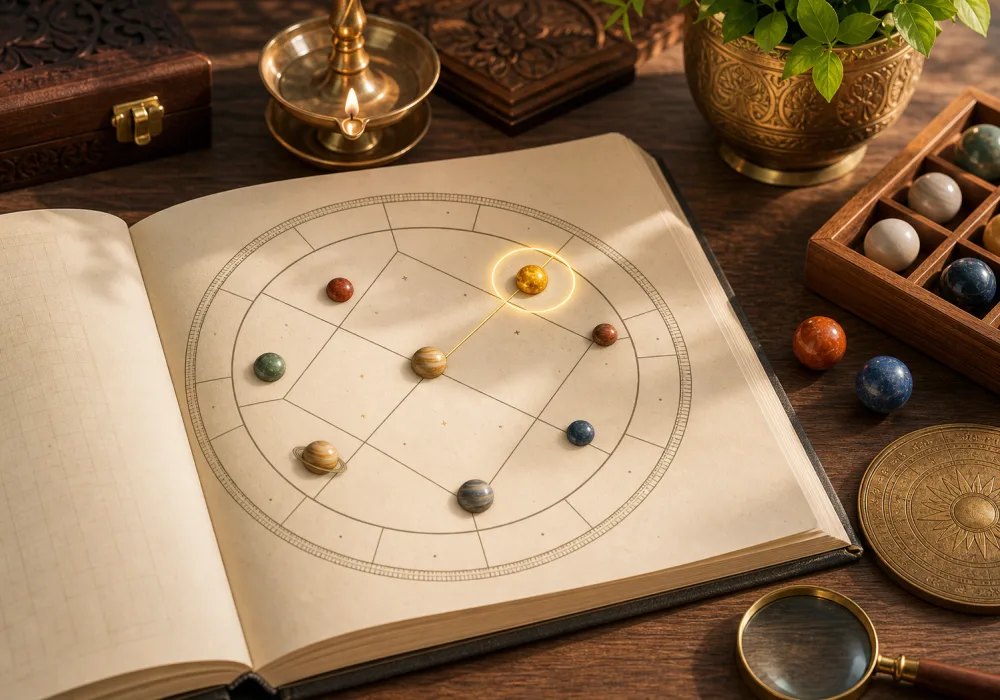
Follow this simple workflow:
- Generate your sidereal Vedic birth chart.
- Note the degree of each visible planet within its sign: Sun, Moon, Mars, Mercury, Jupiter, Venus, and Saturn.
- Ignore the sign number and compare only the degrees inside each sign.
- The planet with the highest degree is your Atmakaraka.
- Then check where that planet sits by house, sign, dignity, aspects, and D9 placement.
Example: if Venus is at 28 degrees Taurus, Mars is at 24 degrees Leo, Jupiter is at 19 degrees Scorpio, and the remaining planets are lower, Venus becomes the Atmakaraka in this method.
Some traditions include Rahu and calculate it differently because Rahu moves retrograde. Others use a seven-karaka system. If you are learning, pick one method consistently and note which system your astrologer or software uses.
Atmakaraka Planet Meanings
The planet itself gives the first clue, but it is only the starting point.
| Atmakaraka | Reflection theme | Balanced expression |
|---|---|---|
| Sun | Identity, authority, self-respect | Leadership with humility |
| Moon | Emotional safety, care, belonging | Sensitivity with steadiness |
| Mars | Courage, anger, action | Discipline without aggression |
| Mercury | Speech, learning, adaptability | Cleverness with ethics |
| Jupiter | Wisdom, faith, guidance | Belief with discernment |
| Venus | Love, pleasure, harmony | Beauty with commitment |
| Saturn | Duty, patience, endurance | Responsibility without bitterness |
Do not read this table as a final verdict. A Saturn Atmakaraka does not mean lifelong suffering, and a Venus Atmakaraka does not mean effortless love. The house, sign, strength, aspects, and current dasha decide how the theme shows up.
For a strength check, compare the Atmakaraka with the planetary strength calculator guide and the planets in Vedic astrology guide.
Why D9 and Karakamsha Matter
Atmakaraka becomes especially useful when you place it in the Navamsa (D9). The D9 sign occupied by the Atmakaraka is often called Karakamsha. Many Jaimini practitioners read Karakamsha as a subtle lens for dharma, inner motivation, and spiritual direction.
This is why beginners should not stop at “my Atmakaraka is Mars.” A better reading asks:
- Where is Mars in the main birth chart?
- What house does it rule for the ascendant?
- Is it supported or pressured by other planets?
- Where does it go in the D9 chart?
- What houses are counted from Karakamsha?
- Is the running dasha activating the same planet or house?
If D9 is new to you, start with the divisional charts introduction before making spiritual conclusions from one placement.
A Practical Atmakaraka Worksheet
Use this short worksheet before asking for a full reading:
| Question | Your note |
|---|---|
| Which planet has the highest degree? | |
| Which house and sign is it in? | |
| Is the planet strong, weak, combust, retrograde, or afflicted? | |
| Where is it placed in D9? | |
| What repeated life theme matches this planet? | |
| What mature action would balance this theme? |
The last question matters most. If Mercury is Atmakaraka, your growth may involve truthful communication, study discipline, or nervous-system steadiness. If Saturn is Atmakaraka, the growth path may involve patience, boundaries, service, and long-term effort. Astrology becomes useful when it turns symbolism into practical choices.
Common Mistakes to Avoid
Treating Atmakaraka as a fate sentence
Atmakaraka is a lens, not a verdict. It highlights a lifelong learning pattern, but your habits, environment, relationships, and choices still matter.
Reading the planet without house context
The same Venus Atmakaraka can speak differently in the 1st, 7th, 10th, or 12th house. Always read house, sign, dignity, aspects, and dasha together.
Ignoring the Moon and Nakshatra
Atmakaraka is advanced, but your Moon sign and Nakshatra still shape daily perception and timing. Use the Nakshatra finder guide if you want the emotional layer behind the chart.
Copying remedies from generic lists
Do not wear gemstones, start intense mantras, or perform expensive rituals only because you saw one Atmakaraka label. Remedies should match the full chart, current dasha, and real-life need.
Frequently Asked Questions
Is Atmakaraka the most important planet in a chart?
Atmakaraka is highly important in Jaimini astrology, but it is not the only important planet. Lagna lord, Moon, Sun, dasha lord, house rulers, and yogas all matter. Treat Atmakaraka as a deep self-inquiry point within the full chart.
Can Rahu be Atmakaraka?
Some Jaimini traditions include Rahu among the Chara Karakas, while many beginner-friendly calculators use only seven planets and exclude Rahu and Ketu. If Rahu is included, the calculation method differs because Rahu moves retrograde. Check your software setting before comparing results.
What if my Atmakaraka is debilitated?
A debilitated Atmakaraka suggests the theme may require humility, support, and conscious practice. It does not mean failure. Look for cancellation factors, aspects from benefics, D9 placement, and dasha timing before judging the planet harshly.
How often does Atmakaraka change?
Your natal Atmakaraka does not change because it is calculated from your birth chart. What changes is how strongly the theme feels during dashas, transits, major life choices, and spiritual practice.
Conclusion
Atmakaraka meaning in Vedic astrology is best understood as a mirror for the soul’s recurring lesson. Find the highest-degree planet, read it through the full chart and D9, then translate the symbolism into grounded action. If you want a cleaner starting point, generate your Kundli, confirm your birth details, and compare Atmakaraka with dashas before drawing conclusions.
For personal chart work, start with VedicGod’s birth chart tools and use Atmakaraka as one thoughtful layer among many.
Further Reading
Continue your astrology study
Related guides and tools
Understand Dasha Sandhi in Vedic astrology: what it means, why Mahadasha transitions feel intense, what to review, and how to plan calmly.
advanced Saptamsa D7 Chart: Children & Creativity GuideLearn how to read the Saptamsa D7 chart in Vedic astrology for children, creativity, legacy, and timing without treating one placement as destiny.
advanced How to Use the Longevity Calculator: Practical StepsComplete Vedic astrology longevity calculator guide. Learn how to calculate lifespan indicators and understand planetary health influences.
advanced Longevity Calculator: Map Your Vedic Wellness TimelineMap your Vedic wellness timeline with our Longevity Calculator guide. Measure Moon, Saturn, and Jupiter influences, plan health rituals, and schedule remedies.
advanced Nadi Astrology Consultation: Palm Leaf Reading GuideUnderstand Nadi astrology consultation, palm leaf reading process, accuracy limits, booking questions, red flags, and how to prepare your Kundli.