Saptamsa D7 Chart: Children & Creativity Guide
Quick answer: The Saptamsa D7 chart is a Vedic astrology divisional chart used to refine themes around children, creativity, lineage, mentoring, and what a person nurtures into the world. Read D7 only after the main birth chart, with accurate birth time, dasha timing, and grounded real-life context.
The Saptamsa D7 chart can feel sensitive because many people approach it with questions about children, family continuity, or creative legacy. A helpful reading does not make absolute promises. It studies the main birth chart first, then uses D7 as a focused lens for how nurturing, creation, teaching, and responsibility may mature over time.
If you are new to Vargas, start with the divisional charts guide and confirm your birth data through the Kundli chart calculator guide before drawing conclusions from D7.
Key Takeaways
- D7 refines themes of children, creativity, students, projects, and legacy.
- A Saptamsa reading starts with the D1 birth chart, especially the 5th house, 5th lord, Jupiter, Moon, and relevant dashas.
- D7 is birth-time sensitive, so rounded or uncertain times should be interpreted cautiously.
- Use D7 for reflection and planning, not medical, fertility, or family certainty claims.
Contents
- What the Saptamsa D7 Chart Shows
- How D7 Is Calculated
- The 5-Step Saptamsa Reading Workflow
- Key Houses and Planets in D7
- Common D7 Mistakes to Avoid
- FAQ
What the Saptamsa D7 Chart Shows
Saptamsa means the seventh division. In this varga, each 30-degree zodiac sign is divided into 7 parts, so each division spans about 4 degrees and 17 minutes. Classical Jyotish texts discuss divisional charts as refinement tools; modern readers often reference Brihat Parashara Hora Shastra for this broader varga framework (Internet Archive scan).
In practical readings, D7 is used for:
- Children, parenting themes, and relationship with dependents
- Creative works, students, apprentices, and intellectual legacy
- The quality of what you nurture over time
- Support or pressure around the 5th-house promise
- Timing windows when family or creative responsibilities become active
The word “children” should be read carefully. D7 can describe biological children, adopted children, stepchildren, mentoring roles, creative output, or projects that require patience and protection. If the question involves fertility, pregnancy, health, or medical decisions, qualified medical guidance comes first. Astrology can support reflection, not replace care.
How D7 Is Calculated
The Saptamsa chart divides each sign into seven equal parts. Because the divisions are small, a slight birth-time error can move sensitive points. This is why D7 should not be judged from a family-estimated time such as “around sunrise” or “after lunch” unless the reading is kept broad.
For timing, Vedic astrology also relies heavily on the Moon, nakshatras, and dashas. NASA notes that the Moon completes an orbit around Earth in about 27 Earth days, while from Earth it appears to cycle through phases over about 29 days (NASA Moon facts). Jyotish uses lunar movement symbolically and mathematically, which is one reason exact birth data matters.
If your birth time is uncertain, read the birth time accuracy guide before relying on any divisional chart. D7 can still be useful, but it becomes a reflective lens rather than a precise verdict.
The 5-Step Saptamsa Reading Workflow
Use this sequence before interpreting individual placements:
- Check the D1 birth chart, especially the 5th house, 5th lord, Jupiter, Moon, and Putra-related yogas.
- Confirm the strength and condition of the Lagna and Lagna lord, because the whole chart must support the promise.
- Open D7 and read the Saptamsa lagna, lagna lord, 5th house, and 5th lord.
- Compare repeated planets or signs between D1 and D7.
- Add dasha and transit timing only after the promise and quality are clear.
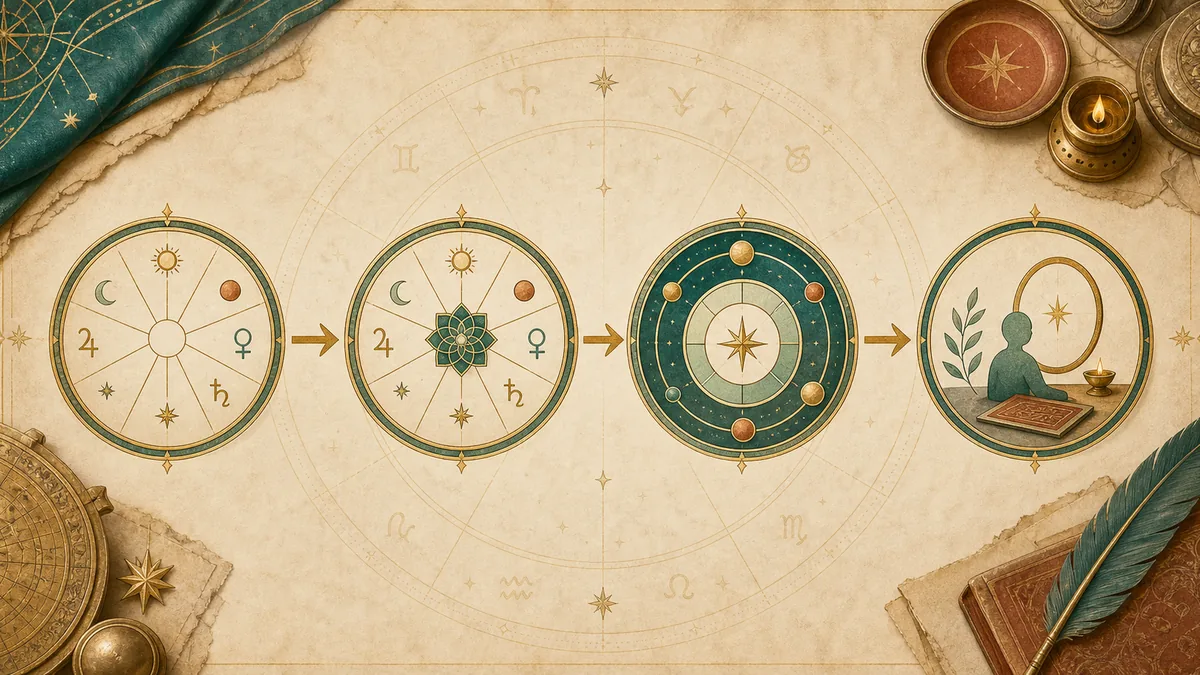
This workflow keeps the reading balanced. A strong D7 cannot create a theme that the main chart does not support, and one difficult placement in D7 does not cancel the whole promise.
Key Houses and Planets in D7
The D7 lagna shows the inner tone of nurturing, creation, and responsibility. A supported lagna lord can suggest resilience in parenting, teaching, or long creative commitments. A pressured lagna lord may show that the person needs structure, emotional support, or patience before the theme feels stable.
The D7 5th house is central. It describes joy, creativity, children, learning, mantra, and the ability to guide something young or unfinished toward maturity. Benefic support can make this area smoother. Malefic influence may not deny results; it can show delay, discipline, duty, or a serious approach.
The D7 9th house matters because it reflects blessings, teachers, dharma, and family wisdom. The 2nd house shows family continuity and speech patterns inside the household. The 11th house can show gains, support networks, elder siblings, communities, and the fulfillment of hopes.
Among planets, Jupiter is traditionally important for children, wisdom, counsel, and expansion. The Moon shows emotional availability, caregiving rhythm, and the mind’s receptivity. Venus can show affection and creative refinement. Saturn may show delay or responsibility, but also endurance. Mars can show protective energy, impatience, or competitive creativity. Rahu and Ketu can indicate unconventional paths, adoption themes, distance, detachment, or unusual creative directions when supported by the wider chart.
D7 and Timing
Saptamsa can help refine timing, but it should be paired with dashas and transits. Look for periods involving the D1 5th lord, D7 lagna lord, D7 5th lord, Jupiter, Moon, or planets connected to the 5th house. A transit may open a window, but the dasha shows which planetary theme is actually active.
For example, a Jupiter period connected to the 5th house may support teaching, parenting, publishing, mentoring, or creative expansion. A Saturn period may ask for patience, responsibility, documentation, and consistent effort. Rahu may bring unconventional family structures, online teaching, foreign links, or experimental creative work.
Use the dasha periods guide to understand timing before making the reading too literal. For comparison, the Navamsa D9 marriage guide and Dashamsa D10 career guide show the same principle: first confirm the D1 promise, then refine with the relevant varga.
Common D7 Mistakes to Avoid
Do not read D7 as a yes-or-no fertility chart. It is not a medical report and should never replace clinical care, family counseling, or practical planning.
Do not panic over Saturn, Mars, Rahu, or Ketu in D7. These planets can show responsibility, pressure, complexity, or unconventional expression, but their results depend on dignity, aspects, house ownership, and dasha timing.
Do not use D7 without birth-time caution. Divisional charts are more sensitive than the main birth chart. If the birth time is rounded, use wider themes and avoid exact predictions.
Do not limit D7 to biological children only. Many people live their 5th-house and D7 promise through students, nieces and nephews, community leadership, books, art, businesses, spiritual practice, or long-term creative work.
A Simple Self-Check for Your Saptamsa
Before asking what D7 “predicts,” ask better questions:
- Does the D1 chart support 5th-house themes?
- Is the D7 lagna lord supported or under pressure?
- What does the D7 5th house show about nurturing and responsibility?
- Which planet repeats between D1 and D7?
- Is the current dasha activating children, creativity, teaching, or legacy themes?
- What grounded action matches the chart: patience, planning, mentoring, counseling, study, or creative discipline?
FAQ
What is the Saptamsa D7 chart used for?
The Saptamsa D7 chart is used to refine 5th-house themes such as children, creativity, students, mentoring, and legacy. It should be read after the main birth chart, not by itself, because D7 confirms and qualifies a promise already shown in D1.
Can D7 predict the exact number of children?
D7 is not reliable as a standalone tool for exact-count predictions. Some astrologers may study combinations for quantity, but a grounded reading focuses on support, timing, responsibility, and quality of experience rather than making rigid claims.
Is Saptamsa only for parents?
No. Saptamsa can also describe creative projects, teaching roles, mentorship, spiritual practice, and the work a person nurtures across time. For some charts, the D7 promise may express more strongly through creativity or guidance than through parenthood.
What if my D7 chart looks difficult?
A difficult D7 chart does not mean denial or failure. It may show delay, responsibility, emotional learning, or a need for stronger support systems. Always compare D7 with D1, dashas, transits, and practical life context before concluding.
Final Takeaway
The Saptamsa D7 chart is a refinement tool for what you nurture into life. It can describe children, students, creative work, and legacy, but it should be read gently and responsibly.
Start with your birth chart, confirm the 5th-house promise, then use D7 to understand quality and timing. For a personalized reading, use VedicGod to compare your D1 chart, Saptamsa, and current dasha before turning chart symbolism into life decisions.
Continue your astrology study
Related guides and tools
Atmakaraka meaning in Vedic astrology: learn how to find your soul significator, read it with D9/Karakamsha, and use it for grounded reflection.
advanced Dasha Sandhi: Meaning, Signs, and Transition GuideUnderstand Dasha Sandhi in Vedic astrology: what it means, why Mahadasha transitions feel intense, what to review, and how to plan calmly.
advanced How to Use the Longevity Calculator: Practical StepsComplete Vedic astrology longevity calculator guide. Learn how to calculate lifespan indicators and understand planetary health influences.
advanced Longevity Calculator: Map Your Vedic Wellness TimelineMap your Vedic wellness timeline with our Longevity Calculator guide. Measure Moon, Saturn, and Jupiter influences, plan health rituals, and schedule remedies.
advanced Nadi Astrology Consultation: Palm Leaf Reading GuideUnderstand Nadi astrology consultation, palm leaf reading process, accuracy limits, booking questions, red flags, and how to prepare your Kundli.